
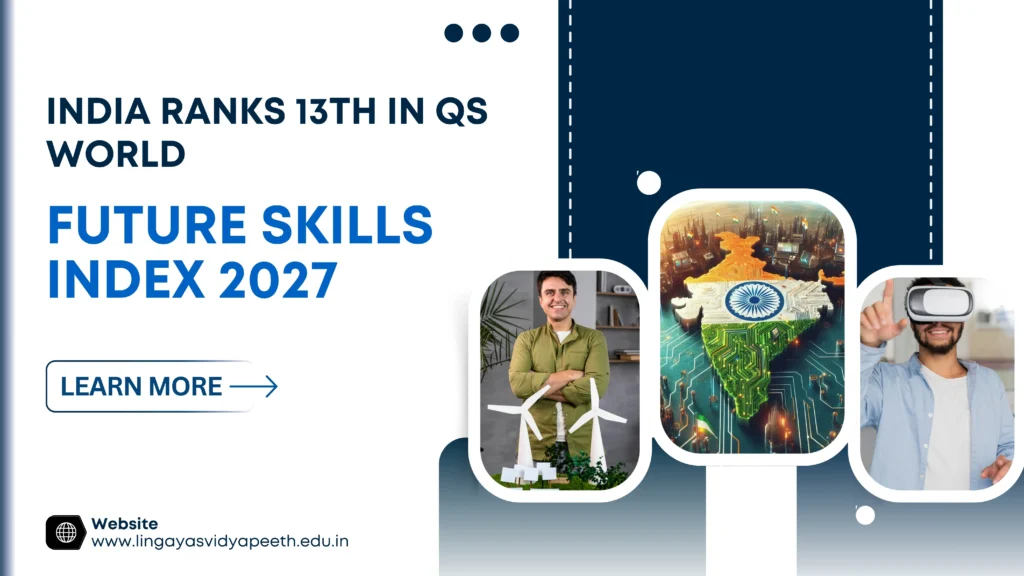
India has achieved a proud milestone by securing the 13th position globally in the QS World Future Skills Index 2027. This ranking shows the country’s growing strength in preparing for jobs of the future, especially in AI, digital technology and green sectors. For students, this news brings hope and a clear message: the skills you build today can open doors in a fast-changing world.
The QS World Future Skills Index, released by Quacquarelli Symonds (QS), looks at how well countries prepare their people for tomorrow’s jobs. It studies 89 economies and checks how education matches the needs of employers in an AI-driven economy. India earned an overall score of 89.4 out of 100, making it the top performer among lower-middle-income countries and in South Asia.
What Is the QS World Future Skills Index?
This index does not just rank universities. It measures how well a country’s education system prepares young people for real work. It uses four main pillars, each given equal weight:
- Skills Alignment: How well graduate skills match job demands.
- Academic Readiness: Quality and readiness of higher education.
- Future of Work: Preparedness for AI, digital and green jobs.
- Economic Transformation: How the economy adapts to new opportunities.
These pillars help show the full picture of a nation’s readiness for future jobs.
India’s Strong Performance: Key Highlights
India’s rank of 13th places it ahead of many developed nations like Sweden (14th) and Japan (15th). Here is a clear breakdown of India’s scores:
- Future of Work: 5th rank globally with a score of 96.0 – one of the best performances.
- Economic Transformation: 14th rank with 93.3.
- Academic Readiness: 22nd with 85.7.
- Skills Alignment: 18th with 82.7.
- Economic Capacity (a related measure): Perfect score of 100 (1st in the world).
These numbers tell an exciting story. India shines in areas linked to new technologies and economic growth. The country has the world’s largest IT workforce of about 5.8 million professionals. It contributes around $300 billion to the economy every year. AI investments have already reached $90 billion.
Why this matters for students:
- High readiness in Future of Work means more opportunities in AI, data science, cybersecurity and sustainable jobs.
- India’s massive education system produces the largest number of tertiary-educated people in the world.
- Strong economic growth creates millions of new jobs every year.
Strengths That Make India Stand Out
Several factors helped India reach this position:
- Digital Talent Pool: India leads in producing engineers and tech professionals. Many global companies rely on Indian talent for innovation.
- Economic Momentum: Consistent GDP growth and infrastructure projects make India attractive for investment.
- Policy Push: The National Education Policy (NEP) 2020 focuses on skill-based learning, flexibility and industry partnerships.
- AI and Green Focus: Government and private sector efforts in AI and renewable energy create future-ready careers.
India outperforms most countries in its income group by a big margin. The next lower-middle-income peer ranks much lower at 38th.
Challenges That Still Need Attention
The report also points out areas for improvement. The biggest gap is between the huge number of graduates and the quality of skills they have. While India produces talent at scale, many employers say graduates need better practical training for AI and digital roles.
Other points:
- Skills Alignment score of 82.7 shows room to make education more job-focused.
- Regional differences in education quality still exist.
- Some traditional sectors like agriculture and BPO face automation risks.
These challenges are not new, but they create real opportunities for students who act now.
What This Ranking Means for Students
As a student, this ranking is good news for your future. Here are simple tips to take advantage:
- Focus on Future Skills: Learn AI basics, coding, data analysis, critical thinking and communication. Many free or low-cost online courses are available.
- Choose Practical Learning: Look for internships, projects and certifications that connect classroom knowledge with real work.
- Explore New Fields: Green jobs in renewable energy, sustainable agriculture and climate tech are growing fast.
- Build a Strong Foundation: Strong basics in math, English and problem-solving help in any career.
- Stay Updated: Follow industry trends through platforms like LinkedIn, Coursera, or government skill portals.
Remember, employers value people who can learn quickly and solve problems. The QS report shows that countries succeeding in Future of Work combine technology with human skills.
Government and Education Steps Forward
The Indian government is working hard through NEP 2020 to fix gaps. Key efforts include:
- More focus on vocational and skill courses.
- Partnerships with foreign universities for better programs.
- Encouragement for research and innovation in higher education.
- Schemes like Skill India to train millions in emerging technologies.
Experts believe that faster implementation of these policies, especially in smaller cities and towns, will help close the skills gap. Transnational education (TNE) partnerships can also bring world-class learning closer to more students.
Looking Ahead: Opportunities for Viksit Bharat
By 2030, successful AI adoption could add $500 billion to India’s economy. This growth will create lakhs of new jobs. India aims for Viksit Bharat (Developed India) by 2047 and skills will play a huge role in making this dream real.
Students who prepare well can become part of this success story. Whether you dream of becoming a software engineer, AI researcher, green entrepreneur, or data scientist, the foundation is strong.
Final Thoughts
India’s 13th rank in the QS World Future Skills Index 2027 is a proud achievement. It shows the country’s potential as a leader in the AI age. But rankings are not the end – they are a starting point for action.
For every student reading this: Your efforts matter. Build skills, stay curious and keep learning. The future belongs to those who prepare for it today. With the right mindset and support from education reforms, India can climb even higher in coming years.
Also Read
Why Do International Patients Choose India for Healthcare?
How to Become a Forensic Psychologist
India Wins Women’s 4x100m Relay Gold at Asian Relays
How to Become a Playback Singer